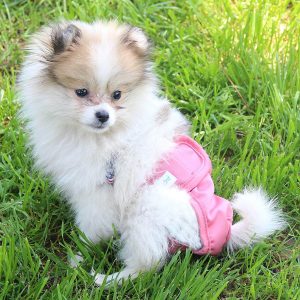
 The first thing every new puppy owner wants is that his/her puppy will stop urinating and defecating in the house. This is a very natural request for humans but dogs, as long as they don’t have to soil their beds, could care less about the exact location of soiling. The concept of housetraining is simple to understand but requires time and commitment from the owner. The more time you will spend house training in your puppy’s first few months of life, the sooner your puppy will stop soiling in the house. The basic idea behind housetraining is that dogs do not soil their living and dining areas. We can use this fact to our advantage when the puppy is left alone as will be discussed later in this section.
You should know that puppies have a hard time controlling their bowl and bladder and the younger the puppy is, the harder it is for him to hold his bladder. A good rule of thumb to remember is that a puppy can hold his bladder for a duration in hours that is equal to the puppy’s age in months plus one hour. For example, if your puppy is 3 months old, the longest he can hold his bladder is 4 hours. This is only a general rule, some puppies can do better and many can do only worse. You should only remember that eating, drinking, playing, running, and sleeping are usually followed with a potty break, you would be wise to take your puppy outside after each nap time, play time, and feeding time, regardless of the last time he went on a potty break.
Due to the popularity of this subject, there is much misleading information about it. every person who had a dog or has a dog gives erroneous advice and puppy owners try everything anyone tell them since they look for the quickest solution. Regardless of what you were told, punishing your dog, physically hitting the dog, hitting with a rolled up newspaper, and shoving the puppy’s face into the urine or stool is always contraindicated and you should never do it. not only do those actions fail to housetrain your dog, they can actually interfere with the housetraining process. You should realize that your puppy cannot make the connection between anything he is doing and any consequence that comes after the fact. If your puppy peed on the carpet 10 seconds ago, 2 minutes ago, or 3 hours ago, there is nothing you can do to tell him that he did something wrong. Every time you punish your dog after the fact, all you are doing is teaching him that you are a dangerous person in random times. When dog owners say that their dog “knows” he did something wrong because he looks “guilty” they are misreading the dog’s language. Dogs do not act “guilty” they act submissively. The reason for submission is probably your body language and tone that is always followed with a punishment. They act submissively because they are trying to stop your aggression towards them.
 Punishing your dog while he is urinating or defecating teaches the dog that it is dangerous to engage in those acts in front of you. If you do it enough times, you can find yourself in a situation where the dog will do his best to avoid soiling in front of you. He will wait until you cannot see him, or go behind a large furniture and soil. This fact will make it extremely hard to tell your dog where you do want him to urinate in the future. Now that you know what you should not do, let’s describe what you should do in detail.
We must start housetraining by letting the puppy what we want her to do. We do that by giving her a treat immediately after she finishes urinating or defecating outside. The keyword here is immediately. Remember that dogs cannot make associations after the fact. The instant the puppy finishes give several treats accompanied with much praise and petting. You cannot be over dramatic about how happy you are with your puppy. Make sure you do it every time. Always go outside with a bag full of treats so you do not miss a chance of rewarding your puppy. If you are consistent, you will that in only a few days your puppy is immediately looking for you after she finishes her business. Make sure you continue rewarding and know that you are well on your way to a housetrained dog.
People sometimes take their puppies straight back home after they finish their business outside. This would be a bad habit as going back inside can be seen by your puppy as punishment. Make sure that “going outside” is always followed by a short trip and never signals the end of the trip. This can be easily done – only a few more minutes after the puppy is done are enough. The more consistent you will be and the more positive reinforcing events you will accumulate, the better the chances your puppy will want to “go potty” outside.
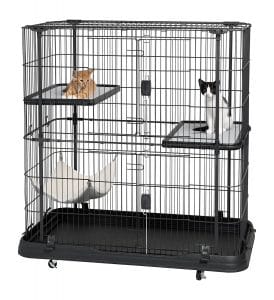
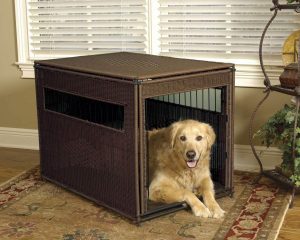
 This practice, however, is not enough, and on its own will require much time to complete the housetraining process. We must accompany it by strict prevention when we are in the house. While “going potty” outside is fun (the puppy is reinforced), going inside is also fun since emptying a full bladder or bowl is intrinsically reinforcing. As long as your puppy is not housetrained, she should never be left unsupervised in the house if she is not limited to a small enough space that would prevent her from soiling her sleeping space. If you are home with your puppy and you cannot supervise her (you are watching a movie, doing dishes, etc), she must be in a place where the chances of her soiling is slim – this space is the puppy’s bed. I strongly recommend using a crate for that purpose. Crate training will be explained in detail ahead. The puppy can only get 20-30 minutes of free time after you came back from a trip outside and you know the bladder and bowl are empty. Even then, there is no need to let the puppy roam through the house. The living room, for example, is more than enough.
Remember that every accident in the house teaches the dog that is not so bad soiling inside. In addition, every accident inside the house is a missed opportunity to reinforce outside. If an accident did occur, clean the area with cleaning solution specifically made for these purposes. These products neutralize the smell and prevent the puppy from returning to the same spot to soil again.
Please note that it is not the intention that your puppy will spend her life crated or limited. Limiting the space is done as a management tool to prevent several behavior problems and house soiling is among them. As your puppy grows older, you will be able to gradually allow her more free space without supervision.
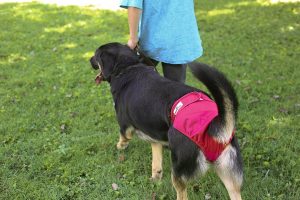 Now, after we accumulated dozens of reinforcements outside and prevented accidents inside to the best of our ability, we can try to stop the puppy when she is trying to soil inside. If you catch your puppy looking for a place to soil or even during the process of soiling, your job is to startle her and get her attention. Yell a quick “no” and add a loud clap if needed, approach her promptly and pick her up in the air. Take her quickly outside, let her finish what she started and reward as always.
Common Mistakes
- Taking too long to deliver the treat after the act of going to the bathroom. You must remember that timing is critical for the dog to make the association between the act and the consequence.
- Giving too much freedom to your puppy. Many dog owners allow their puppy too much space and unsupervised time. Then, they cannot stop the puppy from making mistakes inside the house.
- Punishing the puppy for having accidents in the house – punishing techniques are always contraindicated. They do not help, they can aggravate the problem, and they can hurt the relationship between dog and owner. This is especially true if the punishing comes after the fact.
If it does not Work
- Make sure your puppy is healthy. Various physiological problems in the urinary system can prevent your puppy from learning to hold his /her bladder. Consult your veterinarian and make sure there is no medical problem.
- Start from the beginning and with patience. Impatience is common among dog owners and humans in general. We want fast results and hence we tend to advance too fast in our training. Be patient and continue creating a long history of reinforcements outside while preventing accidents inside. If you are consistent, it will work.
 Consult a reputable dog trainer who uses positive reinforcement methods. The trainer can help you get the timing of reinforcement right, and demonstrate the supervision of a puppy.